
Why Small & Mid-Size CPA Firms Win with White-Label Tax Tech Partnerships
The firms quietly gaining ground this busy season aren’t hiring more staff. They’re partnering smarter.
There’s a quiet shift happening across the CPA landscape. A growing number of small and mid-size firms are closing larger engagements, delivering faster turnarounds, and retaining clients they would have lost two years ago — without adding headcount or blowing up their cost structure.
The common thread? White-label partnerships with tax technology specialists.
I want to make the case for why this model works, why it’s especially powerful for firms under 100 staff, and why the window to act on it is right now.
The Staffing Math Doesn’t Work Anymore
Let’s be direct about what CPA firms are actually facing.
Hiring a senior tax technology professional — someone who can build ETL pipelines, automate depreciation schedules, stand up a data warehouse, and configure Corptax or OneSource — will run you $180,000 to $230,000 fully loaded. That’s before benefits, training, turnover risk, and the 12 to 18 months it typically takes to find and onboard that person in today’s market.
And that’s assuming you can find one. The talent gap in tax technology is real. The professionals who can sit at the intersection of tax compliance and data engineering are rare, and the Big 4 and large regional firms are competing hard for the same pool.
For a 15-person or 40-person CPA firm, that equation simply doesn’t pencil out — not for the volume of tech-intensive work most firms see today.
But here’s the thing: your clients don’t care how the work gets done. They care that it gets done accurately, on time, and at a cost that makes sense. White-label partnerships solve the math problem without sacrificing the client relationship.
What “White-Label” Actually Means in Practice
White-label tax tech partnerships are not outsourcing in the traditional sense. You’re not handing off a client relationship to a third party and hoping for the best.
The model works like this: your firm remains the client-facing relationship. You handle advisory, strategy, and communication. The tax tech partner operates as an invisible extension of your team — building the automation, running the data pipeline, configuring the software, delivering the output — under your firm’s banner.
Your client sees your logo. Your firm owns the relationship. Your team gets deliverables they can review, sign off on, and present with confidence.
The right partner brings deep platform expertise across tools like Alteryx, Corptax, OneSource, Power Query, Power BI, and SQL-based tax data environments. They also bring something equally valuable: production-tested workflows built specifically for tax — not generic automation templates retrofitted to fit tax logic.
That difference matters enormously when you’re dealing with deferred tax rollforwards, ASC 740 provision schedules, or multi-entity consolidations. Generic automation breaks on edge cases. Tax-specific automation is built for them.
The Three Engagements Where This Model Pays Off Fastest
Not every engagement needs a technology partner. But there are three recurring scenarios where the ROI on a white-label partnership is almost immediate:
1. Corporate clients with complex data environments. When a client has multiple ERP systems, inconsistent GL coding, or high transaction volume, data preparation alone can consume 30% to 50% of your engagement hours. A tax tech partner can automate that extraction, transformation, and normalization — often cutting that prep time by 60% or more — freeing your team to focus on analysis and advisory.
2. Provision and ASC 740 work. Tax provision is one of the most technically demanding deliverables in the corporate tax space, and one of the most process-intensive to execute manually. Firms that have automated their provision workflows using tools like Power Query and pivot-driven rollforward models are delivering the same work in a fraction of the time — and charging accordingly.
3. Clients moving off legacy systems. When a corporate client is migrating off a legacy tax platform, transitioning ERP systems, or bringing previously outsourced compliance work back in-house, they need implementation support that most CPA firms aren’t staffed to provide. A white-label partner fills that gap without your firm having to turn away the engagement.
The Competitive Reality
Here’s what the data tells us: corporate tax departments are investing more in automation, not less. The firms that can speak that language — and deliver technology-enabled results — are winning mandates that used to go to the Big 4 by default.
Small and mid-size CPA firms have always competed on relationships, responsiveness, and cost. White-label partnerships add a fourth differentiator: capability.
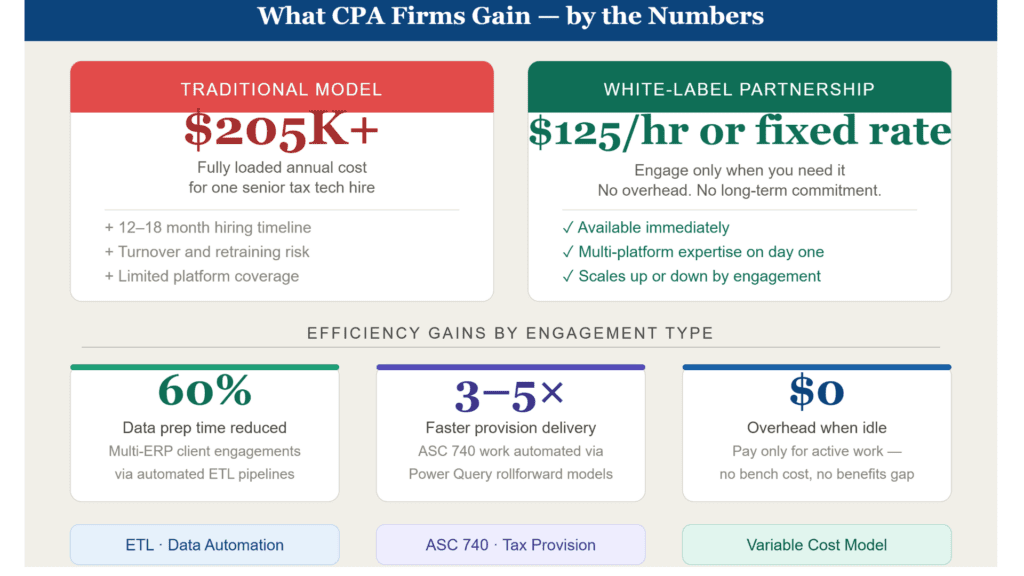
When a 30-person firm can deliver a production-grade automated provision model, a real-time tax dashboard, or a fully mapped ETL pipeline — at a price point well below what a large regional firm would charge — that’s not a small advantage. That’s a market repositioning.
The firms building these partnerships now are establishing the infrastructure to take on larger, more complex clients over the next three to five years. The firms waiting are going to find that gap considerably harder to close later.
A Note on Trust and Control
The most common hesitation I hear from CPA firm partners is about control: If I bring in a partner, what happens to my client relationship?
It’s a legitimate concern. And the honest answer is: the right partner makes your client relationship stronger, not weaker.
When you can deliver faster, more accurate, and more technically sophisticated work — and your client never knows the difference in how it was produced — that’s not a risk to the relationship. That’s the relationship getting stronger.
The firms that understand this are already moving. The firms that don’t are about to find out why their clients are asking their competitors how they do it so fast.
If you’re a CPA firm partner thinking about how to expand your capabilities without expanding your headcount — we’d be glad to talk through what a white-label partnership could look like for your practice.
No pitch deck. No hard sell. Just a straightforward conversation about whether the model fits.